Why Your New Starter Smells Terrible: From Chaos to Culture
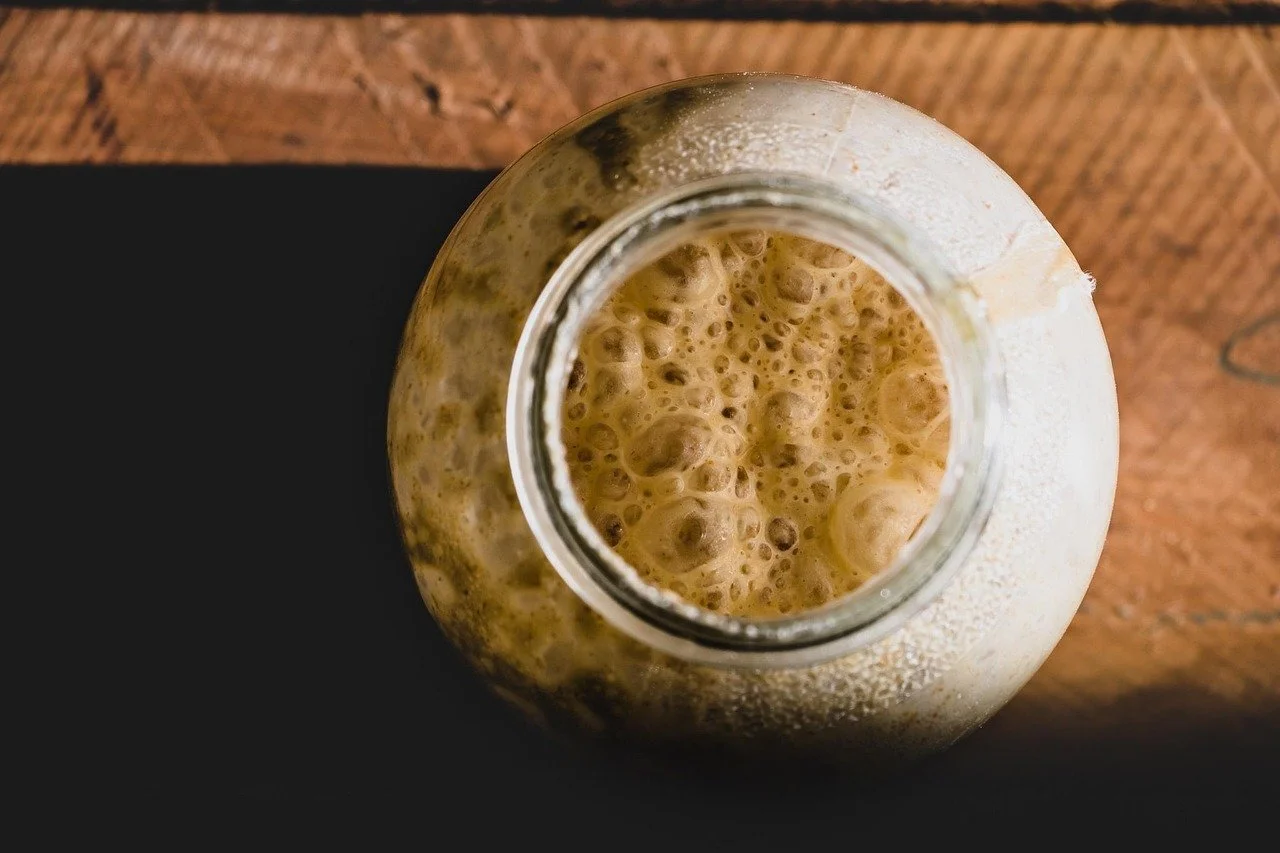
There is a panic that sets in around Day 3 of making a new sourdough starter from scratch. You have mixed flour and water with the reverence of a monk. You have kept it warm. You have whispered encouragement.
And in return, it smells like vomit.
Or perhaps it smells like old socks, or Parmesan cheese left in a hot car.
This is the moment most beginners give up. They assume they have "killed it" or bred a pathogen. But biologically, this stench is not failure. It is succession. It is the necessary, chaotic first act of building a microbial civilisation. Your starter is not dying; it is learning how to be sourdough.
The Law of the Jungle (Ecological Succession)
A jar of flour and water is a blank continent. It is rich in resources (starch) but lacks a dominant ruler. In ecology, what happens next is called succession—a predictable sequence of colonisation where one group of organisms paves the way for the next.
Think of a new volcanic island. First come the lichens, then the grasses, then the shrubs, and finally, the forest. Your starter follows the exact same trajectory, but instead of plants, it is a war between bacteria.
Phase 1: The Opportunists (Days 1–3)
When you mix flour and water, the pH is near neutral (6.0–6.5). This is a playground for "generalist" bacteria that live on the grain or in the air. These are not sourdough bacteria. They are often members of the Enterobacteriaceae family (cousins of E. coli), along with early-stage fermenters like Leuconostoc and Weissella species [1].
These organisms are fast, messy eaters. They produce carbon dioxide (creating a false, frothy rise) and a cocktail of acids that smell, frankly, terrible.
The Vomit Smell: This is often Butyric Acid.
The Cheese/Sock Smell: This is Isovaleric Acid.
The Acetone/Paint Thinner Smell: This is a sign of rapid starch consumption and metabolic stress.
This phase is the "weeding out" period. It is ugly, but necessary. These opportunists are rapidly consuming oxygen and producing the first wave of acid, lowering the pH of the jar.
Phase 2: The Acid Shift (Days 4–7)
The mess made by the Phase 1 bacteria eventually becomes their undoing. As they produce acid, the pH drops below 5.0. Most of the "vomit bacteria" (Enterobacteriaceae) cannot survive in this acidity. They poison themselves with their own waste [2].
Suddenly, the starter goes quiet. The frothy bubbles disappear. The smell fades to something stale. This is the "Valley of Death" for the novice baker. It looks dead, but it is actually the moment of transition.
The environment is now acidic enough to wake up the specialists: the Lactic Acid Bacteria (Lactobacillus species).
Phase 3: The Climax Community (Day 10+)
Once the pH drops below 4.5, the Lactobacillus take the throne. They are acid-lovers (acidophiles). They thrive in the sour environment that killed their predecessors.
As they establish dominance, they begin to produce:
Lactic Acid: A creamy, yogurt-like scent.
Acetic Acid: A sharp, vinegar tang.
Bacteriocins: Antimicrobial peptides that act as a permanent border wall against mould and pathogens [3].
Crucially, this acid-safe haven allows the wild yeasts (Kazachstania humilis or Saccharomyces cerevisiae) to finally wake up and bloom. They couldn't compete in the chaos of Phase 1, but now, protected by their bacterial partners, they begin to produce the carbon dioxide that will leaven your bread.
This stable, self-protecting ecosystem is called a Climax Community. The smell shifts from vomit to ripe fruit, toasted grain, and yogurt. The starter has found it’s sweet spot.
Decoding Your Starter by Smell
Once your starter is established, its smell is no longer a sign of succession, but a signal of state. It is communicating its needs through volatile organic compounds (VOCs).
Ripe Fruit / Yogurt:
The Signal: Healthy fermentation.
The Chemistry: A balance of lactic acid, acetic acid, and ethanol esters.
Action: Feed as normal. It is happy.
Nail Polish Remover (Acetone):
The Signal: Hunger. Starvation mode.
The Chemistry: A reaction between ethanol (alcohol) and acetic acid (vinegar). When food runs out and acidity is high, these compounds combine to form ethyl acetate, which smells like solvent.
Action: It needs food now. Discard heavily (to remove the metabolic waste) and feed with a higher ratio (1:3:3 or 1:5:5) to provide a bigger buffet [4].
Alcohol / Hooch:
The Signal: Long-term neglect.
The Chemistry: Ethanol production has pooled on the surface. The yeast has gone dormant to survive.
Action: Pour off the liquid (or stir it in for a boozier flavour), discard, and feed.
Conclusion: Trust the Process
If you are in the "vomit phase," do not throw your starter away. Do not add commercial yeast. Do not start over.
You are witnessing a biological war that has played out in every sourdough starter for ten thousand years. The good guys always win, provided you keep feeding them. The smell is not a sign of rot; it is the smell of a city being built. Wait for the acid to rise, and the fruit will follow.
References
McKenney, E. A., Nichols, L. M., Alvarado, S., et al. (2023). Sourdough starters exhibit similar succession patterns but develop flour-specific climax communities. PeerJ.
Gobbetti, M., & Gänzle, M. (Eds.). (2012). Handbook on Sourdough Biotechnology. Springer Science & Business Media.
De Vuyst, L., & Neysens, P. (2005). The sourdough microflora: biodiversity and metabolic interactions. Trends in Food Science & Technology.
Hansen, A., & Schieberle, P. (2005). Generation of aroma compounds during sourdough fermentation: applied and fundamental aspects. Trends in Food Science & Technology.
Last updated: 11 December, 2025