
Troubleshoot: The "Fool's Crumb"
Diagnosis Code: P5.17
Subject: Structure Failure (False Alveoli)
In the pursuit of the "Instagram Crumb"—that wild, open lattice of air pockets—many bakers fall into a specific trap. You slice the loaf and see massive, cavernous holes. You celebrate. But when you eat it, the bread is heavy, chewy, and dense.
You have not achieved an open crumb. You have achieved "Fool's Crumb."
It is called this because it fools the baker into thinking they have successfully fermented the dough, when in reality, they have barely started.
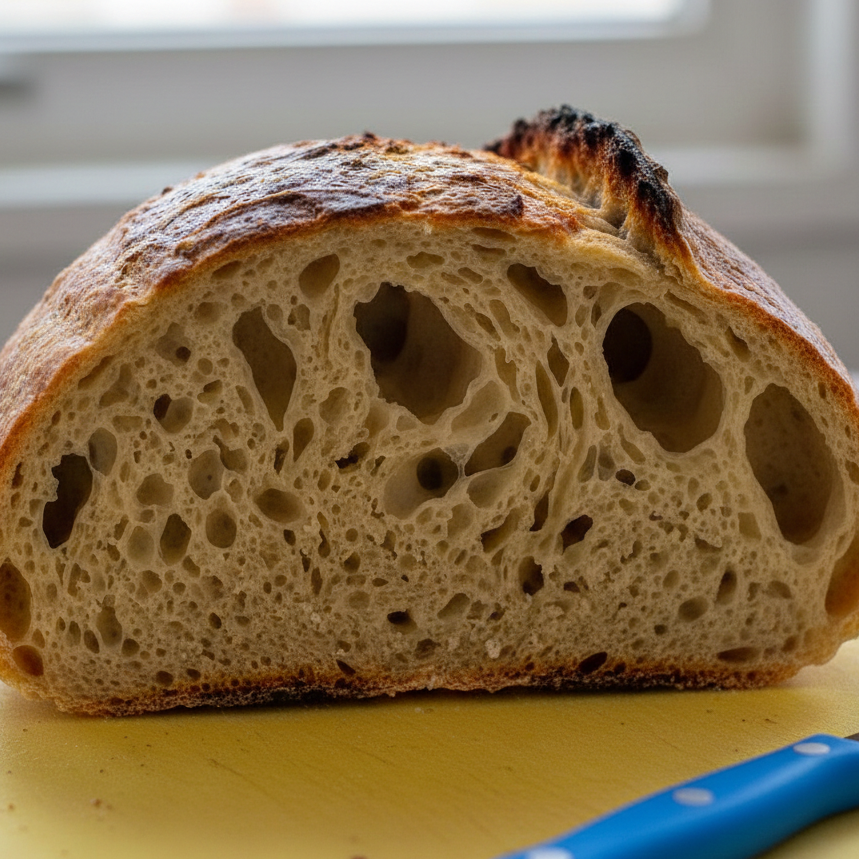
In the pursuit of the "Instagram Crumb"—that wild, open lattice of air pockets—many bakers fall into a specific trap.
You slice the loaf and see massive, cavernous holes. You celebrate. But when you eat it, the bread is heavy, chewy, and dense.
You have not achieved an open crumb. You have achieved "Fool's Crumb."
It is called this because it fools the baker into thinking they have successfully fermented the dough, when in reality, they have barely started.
The Symptom
Visual: The cross-section shows large, random tunnels or caverns, often concentrated near the top crust ("flying roof").
Structural: Crucially, the dough surrounding these large holes is tight, dense, and solid. There is no intermediate aeration.
Tactile: The bread feels heavy for its size. The crumb is tough rather than tender.
The Pathology: Under-Fermentation
Fool's Crumb is almost exclusively a symptom of under-fermentation (under-proofing).
In a properly fermented loaf, the yeast has populated the entire dough mass, creating millions of micro-bubbles that expand evenly. The gluten has been sufficiently acidified to become extensible (stretchy), allowing these bubbles to push against each other without breaking [1].
In an under-fermented loaf, the yeast colonies are sparse or haven't had enough time.
The Gas Trap: The few active yeast clusters produce gas aggressively. Because the surrounding gluten is still tight and unrelaxed (due to low acidity), this gas cannot distribute evenly. Instead, it pools into massive, singular pockets of least resistance [2].
The Dense Matrix: The rest of the dough—where the yeast hasn't reached—remains un-aerated. It bakes into a solid, gummy mass.
The Differential Diagnosis: True vs. Fool
How do you tell the difference between a "Wild Crumb" (Success) and "Fool's Crumb" (Failure)?
Look at the dough between the holes.
True Open Crumb: The lattice is fractal. You have big holes, medium holes, and small holes. The dough strands between the alveoli are thin, lacy, and translucent.
Fool's Crumb: The lattice is binary. You have massive holes and solid dough. The areas between the caverns look like dense sandwich bread or raw paste.
The Prescription
You do not need to change your hydration or your flour. You simply need to buy time.
1. Extend the Bulk Fermentation
You stopped too early. The yeast needed more time to multiply and aerate the dense areas of the dough.
The Fix: Push your bulk fermentation by another 30–60 minutes. Look for a 30–50% increase in volume, not just "bubbly activity."
2. Check Ambient Temperature
Under-fermentation often happens in winter. If your kitchen is $18^{\circ}C$, a recipe written for $24^{\circ}C$ will fail miserably.
The Fix: Use a "warm spot" (top of the fridge, oven with light on) or extend the time significantly to compensate for the cold (see The Heat Spike).
3. Starter Strength (The Lag Phase)
If your starter was weak or used straight from the fridge without a refresh, it may have spent the first 4 hours of bulk fermentation just waking up (Lag Phase).
The Fix: Ensure your starter triples in volume within 4–6 hours before mixing.
Summary
Big holes are not always good holes.
If the bread is heavy, it is under-fermented. Ignore the caverns; look at the masonry. If the walls are thick, the building is not finished.
References
DiMuzio, D. (2010). Bread Baking: An Artisan's Perspective. Wiley.
Hamelman, J. (2004). Bread: A Baker's Book of Techniques and Recipes. Wiley.
Suas, M. (2008). Advanced Bread and Pastry: A Professional Approach. Delmar Cengage Learning.
