
Troubleshoot: Gummy Crumb
Diagnosis Code: P5.16
Subject: Texture Failure (Gumminess)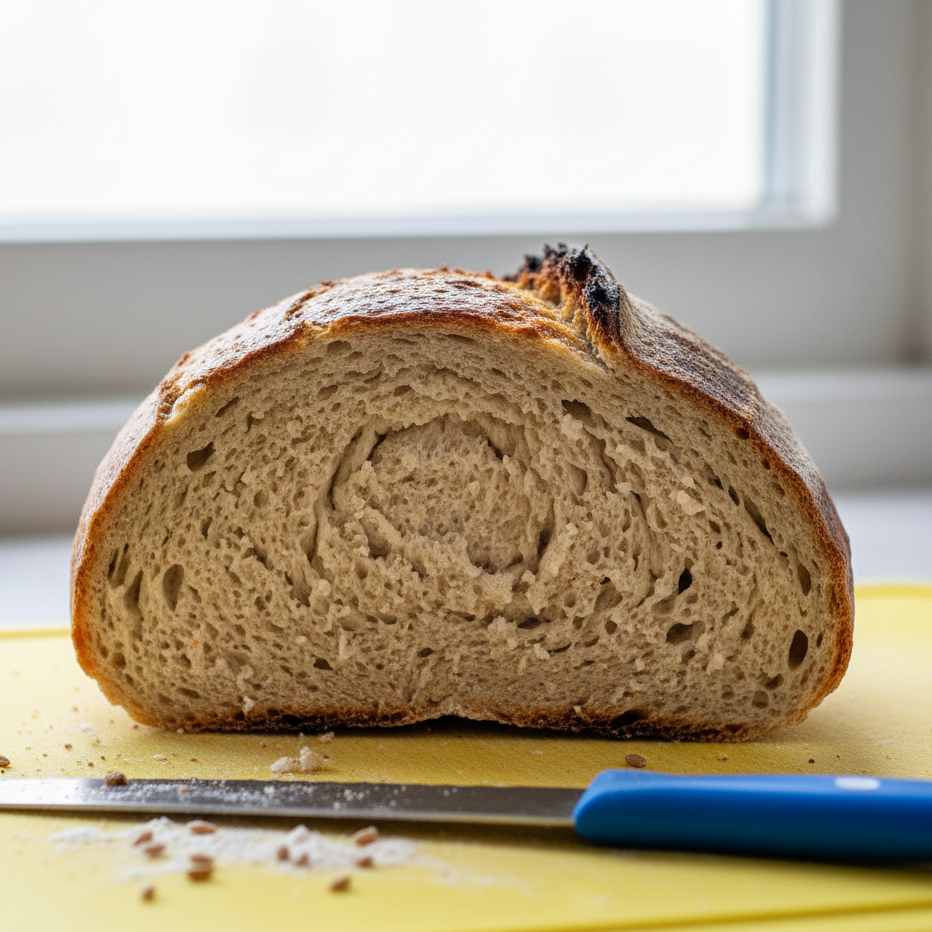
There is a specific heartbreak reserved for the moment you slice a beautiful loaf, only to find the knife coated in a sticky, shiny residue. The crumb looks wet. When you press it, it balls up like putty rather than springing back. It eats like raw dough.
This is "The Gummy Crumb." It is not just a texture flaw; it is a structural collapse.
To fix it, you must identify which of the three distinct biological or physical systems failed.
The Symptom
Visual: The crumb is shiny or "glassy" rather than matte.
Tactile: It feels damp and clammy.
Functional: It sticks to the knife. It does not toast well; it just dries into a hard puck.
Cause 1: The Thermal Failure (Underbaking)
The Probability: High for Beginners.
The Pathology:
Bread is a foam of gelatinised starch and coagulated gluten. For this structure to set permanently, the water inside the starch granules must evaporate or migrate. If the core temperature does not reach approximately $96^{\circ}C$–$98^{\circ}C$, the starches remain in a "sol" (semi-liquid) state [1].
The Diagnostic:
Is the gumminess concentrated in the very centre of the loaf?
Is the crust pale or soft?
The Prescription:
Buy a Probe Thermometer. Do not guess. Insert a probe into the centre of the loaf before taking it out. It must read at least 96°C.
Lower & Longer: If your crust burns before the centre is done, your oven is too hot. Drop the temp by 20°C and extend the bake by 15 minutes.
Cause 2: The Biological Failure (Acid Degradation)
The Probability: High for "Neglected Starter" Bakers.
The Pathology:
This is the most common cause of gumminess in sourdough specifically.
Sourdough creates acidity. Acidity activates enzymes (Proteases). These enzymes act like microscopic scissors, cutting the gluten strands that hold the bread together.
If your dough becomes too acidic (pH < 3.8)—either because your starter was old/hoochy, or you bulk fermented for too long at high temps—the gluten network dissolves. The water that was trapped in the gluten leaks out, creating a wet, dense sludge that no amount of baking can dry out [2].
The Diagnostic:
Did the dough feel "soupier" or stickier at the end of bulk fermentation than at the start?
Did the loaf spread flat in the oven?
Is the crust pale/greyish despite a long bake? (High acidity inhibits the Maillard browning reaction).
The Prescription:
Feed Your Starter: Do not bake with "discard" or hungry starter. Use a young, active, sweet-smelling levain (see The Scrapings Method).
Watch the Bulk: Stop fermentation earlier. If your kitchen is warm ($26^{\circ}C+$), reduce bulk time.
Cause 3: The Patience Failure (The Hot Cut)
The Probability: 100% (We have all done it).
The Pathology:
A hot loaf is still full of mobile water vapour. Cutting it releases pressure, causing the remaining steam to condense instantly back into liquid water on the cut surface.
The Diagnostic:
Did you cut it while it was warm?
If yes, stop diagnosing. You found the cause.
The Prescription:
Wait 2 hours minimum. 4+ hours for high-rye loaves.
Summary
A gummy crumb is rarely a hydration issue (you can bake 100% hydration ciabatta that is not gummy). It is almost always a temperature or acidity issue.
Centre only? Bake longer.
Whole loaf + Pale crust? Your starter is too acidic.
Perfect loaf + Gummy slice? You cut it too hot.
References
Cauvain, S. P., & Young, L. S. (2007). Technology of Breadmaking. Springer Science & Business Media.
Gobbetti, M., & Gänzle, M. (Eds.). (2012). Handbook on Sourdough Biotechnology. Springer Science & Business Media.
Hamelman, J. (2004). Bread: A Baker's Book of Techniques and Recipes. Wiley.
